About the Journal

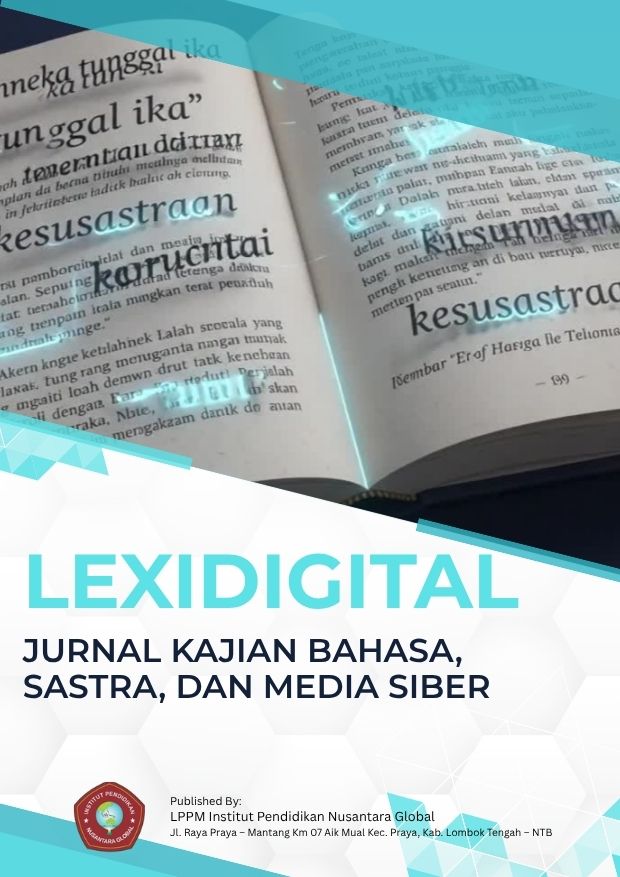
   Journal title  : LexiDigital: Jurnal Kajian Bahasa, Sastra, dan Media Siber
   Initials  : LexiDigital
   Abbreviation  : J. Kaji. Bahasa Sastra Media Siber
   Frequency  : January, April, July, October
   DOI  : https://doi.org/10.55681/aspirasidigital by Crossref
   Online ISSN  : xxxx-xxxx
   Editor-in-Chief  : Ahmad Hadi Pranoto, S.Pd.,M.Pd.
   Publisher  : LPPM Institut Pendidikan Nusantara Global
   Citation Analysis  : [Sinta] [Google Scholar]

LexiDigital: Jurnal Kajian Bahasa, Sastra, dan Media Siber is a peer-reviewed, open-access international journal dedicated to publishing pioneering research at the dynamic intersection of linguistics, literary studies, and cyber media. Positioned as a premier scholarly forum for the digital humanities and communication studies, the journal serves linguists, literary critics, media scholars, digital sociologists, and communication theorists worldwide. LexiDigital prioritizes high-impact empirical research, critical discourse analyses, cyber-literature evaluations, and multimodal semiotic studies. By synthesizing traditional linguistic and literary frameworks with the rapidly evolving digital landscape—including social media algorithms, electronic literature, and digital journalism—the journal fosters a comprehensive understanding of how cyberspace reshapes human expression, narrative structures, and socio-cultural interactions.

Scope and Topics
Reflecting its mandate to champion the study of language and literature within the digital ecosystem, the journal welcomes high-quality original research articles, systematic literature reviews, critical discourse studies, and digital media evaluations within the following thematic areas:

  • Cyber Linguistics & Digital Discourse: Internet linguistics, digital pragmatics, the evolution of cyber-slang, social media discourse analysis, and the socio-linguistic impacts of digital communication.
  • Cyber Literature & Digital Storytelling: Electronic literature, digital narratives (e.g., webtoons, serialized online fiction), fan fiction studies, and the transformation of literary genres in digital platforms.
  • Cyber Media & Digital Journalism: Online news framing, digital media ecology, media literacy, post-truth communication dynamics, and the linguistic analysis of clickbait and digital headlines.
  • Digital Humanities & Computational Linguistics: Corpus linguistics, text mining for literary analysis, digital archiving of traditional literature, and the impact of artificial intelligence (AI) on language and writing.
  • Semiotics & Multimodal Cyber Communication: The semiotics of memes, emojis, and digital visual culture; multimodal discourse analysis in cyberspace; and the representation of cultural identity in digital media.

Publication Frequency
To ensure rigorous editorial oversight while facilitating the timely dissemination of highly relevant digital humanities research, LexiDigital is published semi-annually (2 issues per year, typically scheduled for release in June and December). Special thematic issues focusing on the impact of generative AI on cyber literature, language evolution in virtual reality (VR) spaces, or digital activism discourse may be commissioned by the Editorial Board.

Peer Review Process
LexiDigital enforces a strict double-blind peer review policy to maintain the highest standards of academic integrity, analytical objectivity, and empirical validity across the humanities and digital communication disciplines.

  • Initial Desk Evaluation: Every submission undergoes a preliminary screening by the Editor-in-Chief or a relevant Subject Editor to assess thematic alignment, methodological soundness (linguistic analytical rigor, qualitative digital media research depth, or conceptual logic), and structural compliance. Plagiarism screening via Turnitin/iThenticate is strictly executed at this stage, requiring a similarity index below the journal's maximum threshold.
  • Expert Peer Review: Manuscripts passing the desk evaluation are anonymized and assigned to at least two independent reviewers who are established academic researchers, senior linguists, or digital media studies experts.
  • Editorial Decision: Based on the reviewers' recommendations, the Editorial Board renders one of four decisions: Acceptance, Revisions Required (Minor/Major), Resubmit for Review, or Rejection. The final decision rests entirely on intellectual merit, methodological clarity, and the potential for tangible impact on digital language and media scholarship.

Mission Statement: "The mission of LexiDigital: Jurnal Kajian Bahasa, Sastra, dan Media Siber is to advance global and regional scholarship by publishing rigorous, evidence-based research that bridges traditional humanities with the digital frontier. Grounded in the philosophy that cyberspace is not merely a medium but a transformative cultural ecosystem, the journal aims to democratize linguistic, literary, and media research by providing an unrestricted platform for academic and cultural dialogue. Through the promotion of diverse, rigorous qualitative, quantitative, and critical digital methodologies, LexiDigital seeks to empower digital humanities scholars, inspire communication theorists, and shape a profound understanding of how language and literature evolve in the cyber age."