










About the Journal

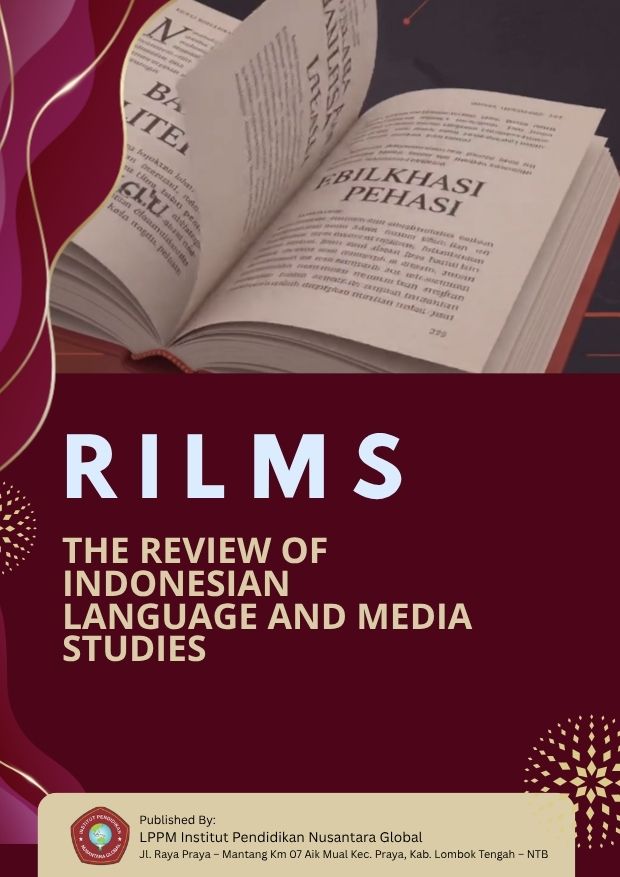
Journal Title : The Review of Indonesian Language and Media Studies (RILMS)
Initial : RILMS
Language : Indonesia and English
e-ISSN : xxxx-xxxx
DOI : https://doi.org/10.55681/JUSDA by  
Publisher : LPPM Institut Pendidikan Nusantaraglobal
Editor-in-chief : Ahmad Hadi Pranoto, S.Pd.,M.Pd.
Frequency : January, April, July, October
Citation Analysis : Sinta | Google Scholar  |  Garuda

The Review of Indonesian Language and Media Studies (RILMS) is a peer-reviewed, open-access international journal dedicated to publishing pioneering research at the intersection of Indonesian linguistics, literature, digital communication, and mass media dynamics. Positioned as a premier scholarly forum for cultural and communication studies, the review serves linguists, media scholars, communication theorists, educators, and cultural researchers worldwide. RILMS prioritizes high-impact empirical research, critical discourse analyses, qualitative media evaluations, and socio-linguistic case studies. By synthesizing the evolution of the Indonesian language (Bahasa Indonesia) with contemporary media ecosystems, digital journalism, and cultural representation, the journal fosters a deep, comprehensive understanding of how language and media collaboratively shape public identity, social discourse, and cultural preservation in the digital age.

Scope and Topics
Reflecting its mandate to champion the interdisciplinary study of language and communication, the journal welcomes high-quality original research articles, systematic literature reviews, critical discourse studies, and applied media evaluations within the following thematic areas:

  • Linguistics & Applied Indonesian Language Studies: Sociolinguistics, pragmatics, semantic shifts, language acquisition, and innovations in teaching Indonesian as a foreign language (BIPA).
  • Media Dynamics & Digital Communication: Digital journalism, social media discourse, broadcasting trends, media literacy, and the evolution of the Indonesian mass media landscape.
  • Critical Discourse & Political Communication: Critical discourse analysis (CDA), media framing, political rhetoric, language in public policy, and the semiotics of digital media.
  • Literature & Cultural Representation: Contemporary and classical Indonesian literature, cultural representation in modern media, cinematic narratives, and digital storytelling.
  • Media Ecology & Technological Impact: The convergence of traditional and new media, the impact of artificial intelligence on Indonesian journalism, and algorithmic influence on language use and digital culture.

Publication Frequency
To ensure rigorous editorial oversight while facilitating the timely dissemination of highly relevant linguistic and media research, RILMS is published semi-annually (2 issues per year, typically scheduled for release in June and December). Special thematic issues focusing on digital literacy in Indonesia, language evolution in social media, or post-truth political communication may be commissioned by the Editorial Board.

Peer Review Process
RILMS enforces a strict double-blind peer review policy to maintain the highest standards of academic integrity, analytical objectivity, and empirical validity across humanities and social science disciplines.

  • Initial Desk Evaluation: Every submission undergoes a preliminary screening by the Editor-in-Chief or a relevant Subject Editor to assess thematic alignment, methodological soundness (linguistic analytical rigor, qualitative/quantitative media research depth, or conceptual logic), and structural compliance. Plagiarism screening via Turnitin/iThenticate is strictly executed at this stage, requiring a similarity index below the journal's maximum threshold.
  • Expert Peer Review: Manuscripts passing the desk evaluation are anonymized and assigned to at least two independent reviewers who are established academic researchers, senior linguists, or media studies experts.
  • Editorial Decision: Based on the reviewers' recommendations, the Editorial Board renders one of four decisions: Acceptance, Revisions Required (Minor/Major), Resubmit for Review, or Rejection. The final decision rests entirely on intellectual merit, methodological clarity, and the potential for tangible impact on language and media scholarship.

Mission Statement

The mission of JUSDA is to deconstruct and elevate the quality of primary education as the cornerstone of lifelong human development and societal progress. Grounded in the philosophy that equitable, innovative, and robust elementary schooling is vital for cultivating critical thinking and democratic citizenship, the journal aims to democratize pedagogical knowledge by providing an unrestricted, high-impact platform for global scholarly dialogue. Through the promotion of diverse methodological approaches—including qualitative action research, quantitative longitudinal studies, and mixed-method designs—JUSDA seeks to empower educators, inspire curriculum innovators, and shape future-proof policies in global elementary education.

JUSDA: Jurnal Sekolah Dasar is indexed and/or available catalogue in: