∴ MENUS ∴
∴ SUBMISSION ∴
∴ JOURNAL TEMPLATE ∴
 |
 |
∴ INFORMATION ∴
∴ ISSN BARCODE ∴
 |
∴ INDEXING ∴
 |
 |
 |
 |
∴ TOOLS ∴
 |
 |
 |
 |
∴ STATISTIC ∴
∴ MEMBER ∴
 |
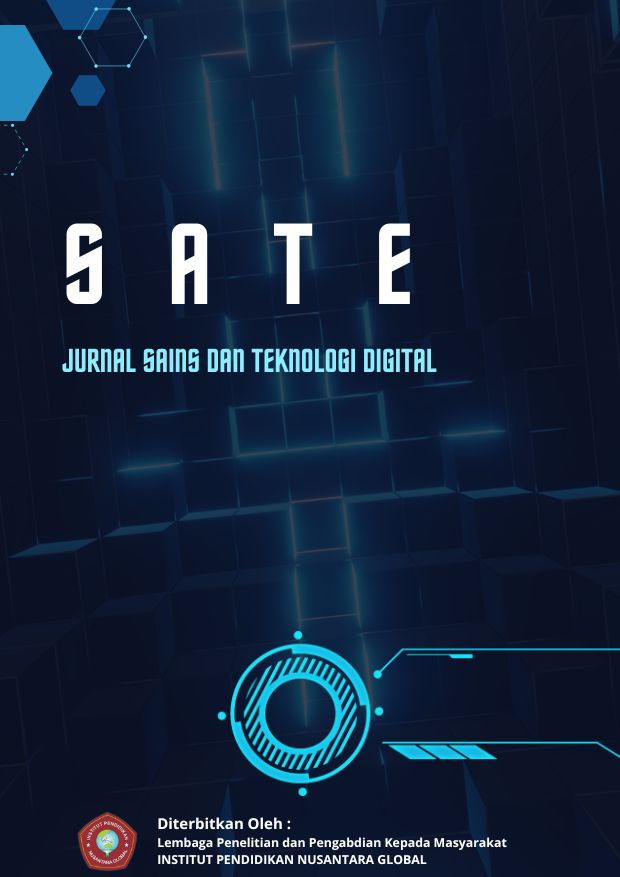
SATE: Jurnal Sains dan Teknologi
Frequency: 4 issues per year
 |
Journal title | : | SATE: Jurnal Sains dan Teknologi Digital | |
| Initials | : | SATE | ||
| Abbreviation | : | SATE J. Sains Teknol. Digit. | ||
| Frequency | : | January, April, July, October | ||
| DOI | : | https://doi.org/10.55681/aspirasidigital by Crossref | ||
| Online ISSN | : | xxxx-xxxx | ||
| Editor-in-Chief | : | Ahmad Hadi Pranoto, S.Pd.,M.Pd. | ||
| Publisher | : | LPPM Institut Pendidikan Nusantara Global | ||
| Citation Analysis | : | [Sinta] [Google Scholar] |
SATE: Jurnal Sains dan Teknologi Digital is a peer-reviewed, open-access international journal dedicated to publishing pioneering research that intersects exact sciences, engineering principles, and the rapidly evolving domain of digital technology. Serving as an intellectual crucible for computational scientists, engineers, data analysts, and technological innovators, the journal provides a high-impact platform for both theoretical breakthroughs and applied practical architectures. SATE prioritizes macro-level systemic designs, cutting-edge digital frameworks, and rigorous empirical models that leverage computational power to solve complex scientific and real-world industrial challenges. By bridging the gap between foundational physical/mathematical sciences and modern digital disruption, the journal accelerates the transformation of empirical science into scalable digital solutions.
Scope and Topics
The journal welcomes high-quality original research articles, critical reviews, and conceptual papers that offer significant contributions to the following thematic areas:
Publication Frequency
To ensure rigorous editorial oversight, thorough peer review, and timely dissemination of cutting-edge research, SATE is published semi-annually (2 issues per year, typically scheduled for release in June and December). Special thematic issues focusing on disruptive technological paradigms or emerging milestones in digital science may be commissioned by the Editorial Board.
Peer Review Process
SATE enforces a strict double-blind peer review policy to maintain the highest standards of academic integrity and technical validity.
Mission Statement: "The mission of SATE is to catalyze technological innovation and advance the frontiers of digitalized scientific research within a rapidly changing planetary ecosystem. Grounded in the philosophy that digital technology is the ultimate accelerant for human knowledge, industrial efficiency, and sustainable engineering, the journal aims to democratize access to cutting-edge tech science by providing an unrestricted, high-impact platform for global scholarly dialogue. Through the promotion of diverse and robust methodological approaches—including experimental validation, algorithmic synthesis, and quantitative simulations—SATE seeks to empower technology practitioners, inspire industrial developers, and shape forward-looking digital policies globally."
∴ MENUS ∴
∴ SUBMISSION ∴
∴ JOURNAL TEMPLATE ∴
|
|
∴ INFORMATION ∴
∴ ISSN BARCODE ∴
|
∴ INDEXING ∴
|
|
|
|
∴ TOOLS ∴
|
|
|
|
∴ STATISTIC ∴
∴ MEMBER ∴
|
SATE: Jurnal Sains dan Teknologi
Frequency: 4 issues per year